
Agentic AI and Business Productivity: What Founders Need to Know
Agentic AI is moving beyond simple chatbots and content generation. Here's how AI agents could change business workflows, productivity and the way small teams operate.
Agentic AI is changing how businesses approach automation. Instead of simply answering questions, AI agents can increasingly reason through tasks, use tools and execute multi-step workflows. Here's what founders need to understand about the next phase of AI-powered business automation.
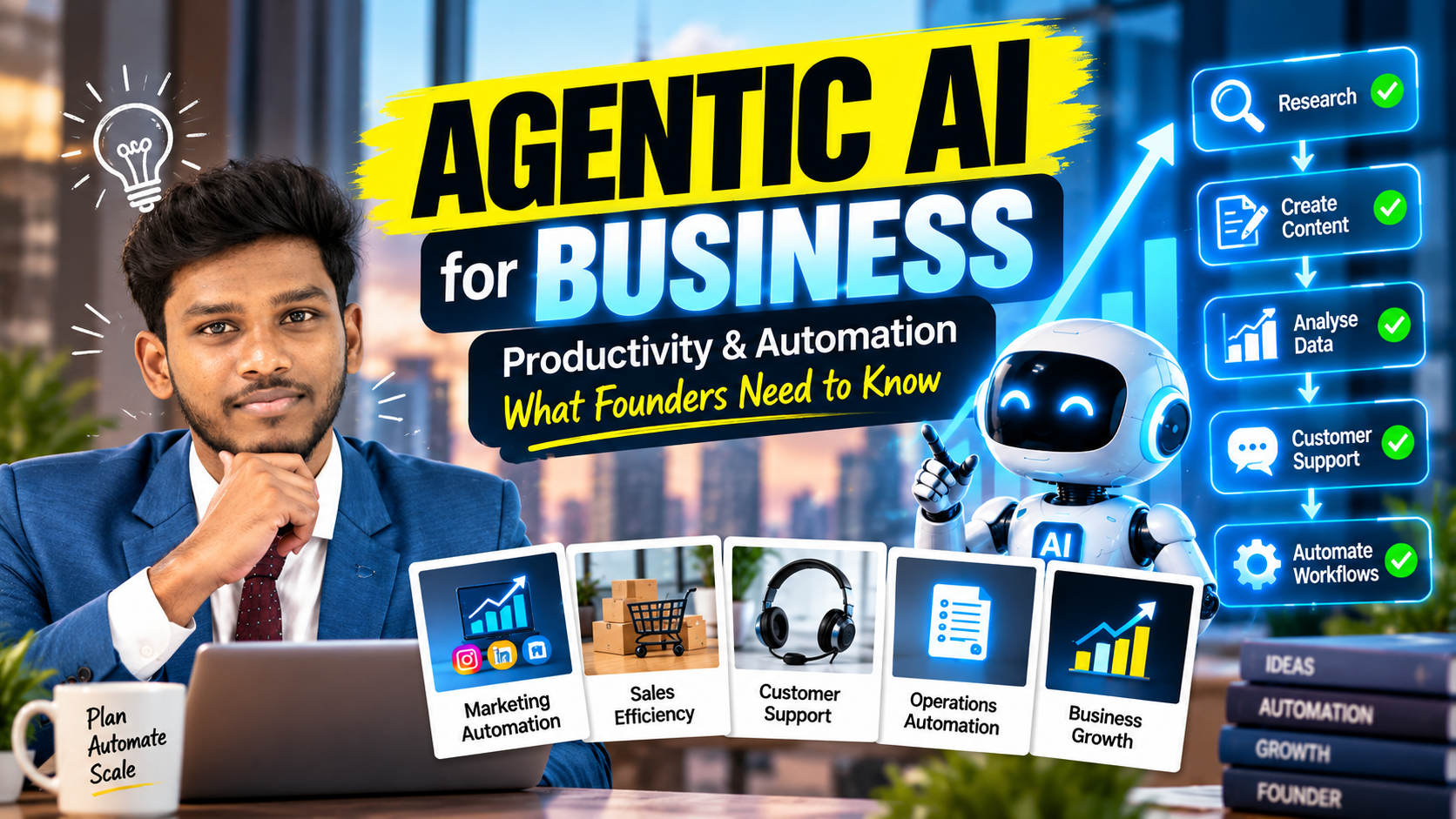
What Is Agentic AI?
Artificial intelligence has already changed how people interact with technology.
Tools like generative AI can write content, analyse information, answer questions and help users complete individual tasks.
But the next step is more significant.
Instead of simply responding to instructions, Agentic AI aims to help complete goals through a series of actions.
An AI agent can potentially:
Understand an objective
Break it into smaller tasks
Use different tools
Gather information
Analyse results
Make decisions within defined boundaries
Execute actions
Report the outcome
This moves AI from being primarily a question-and-answer system toward becoming a workflow execution system.
And that has major implications for businesses.
From AI Assistant to AI Agent
Consider the difference between these two instructions.
Traditional AI assistant:
"Write a competitor analysis for my business."
The AI generates a response.
Useful.
But the human still needs to research competitors, gather information, organise it and decide what to do next.
Agentic AI:
"Monitor my competitors and prepare a weekly competitor intelligence report."
A more advanced AI agent could potentially:
Collect relevant information
Analyse changes
Compare competitors
Identify important developments
Organise the findings
Generate a report
The important difference isn't simply intelligence.
It's agency.
The system is moving toward completing a defined workflow rather than only producing an answer.
Why This Matters for Founders
For a large company, automating one workflow may save hundreds of hours.
For a small business, the impact can be even greater.
A five-person company doesn't have the same resources as a 500-person company.
It cannot afford a large:
Research team
Marketing department
Data team
Customer support department
Operations team
Technology team
AI agents could potentially give smaller teams access to some of these capabilities.
That doesn't mean AI replaces every employee.
It means the productivity capacity of a small team can increase significantly.
And that changes how founders should think about growth.
The New Question: What Can Be Automated?
Most businesses contain dozens of repetitive workflows.
For example:
Marketing
→ Research topics
→ Create content briefs
→ Generate drafts
→ Repurpose content
→ Analyse performance
Sales
→ Qualify leads
→ Research prospects
→ Prepare follow-ups
→ Update CRM
→ Generate reports
Customer Support
→ Categorise tickets
→ Find relevant information
→ Draft responses
→ Identify recurring issues
→ Escalate complex problems
Operations
→ Generate reports
→ Monitor processes
→ Update records
→ Track tasks
→ Identify exceptions
Many of these workflows don't necessarily require a human to manually perform every step.
That's where AI automation becomes interesting.
AI Automation Is Not Just About Saving Time
Time savings are useful.
But the bigger opportunity is capacity.
Imagine a founder currently spending five hours every week analysing competitors.
If AI reduces that to thirty minutes of review, the founder doesn't simply "save four and a half hours."
They now have additional capacity.
That time could be used for:
Talking to customers
Developing products
Building partnerships
Improving marketing
Training employees
Exploring new markets
This is where productivity becomes business value.
The goal isn't:
Do more work.
The goal is:
Spend human attention where it creates the most value.
The Human Still Matters
Agentic AI doesn't remove the need for human judgement.
In fact, the more autonomous AI becomes, the more important good system design and oversight can become.
A business still needs humans to define:
Goals
Constraints
Priorities
Quality standards
Risk boundaries
Approval requirements
For example, you might allow an AI agent to prepare a customer response.
But you may not want it to issue a large refund without approval.
You might allow an AI agent to analyse competitors.
But you may want a human to verify important conclusions.
You might allow an AI agent to create marketing campaigns.
But you may want a human to approve the final campaign.
This creates a model of:
AI execution + human oversight.
The Importance of AI Workflows
One of the biggest mistakes companies make with AI is using individual tools without designing the surrounding workflow.
Buying ten AI subscriptions doesn't automatically make a business AI-powered.
The real opportunity comes from connecting capabilities.
For example:
Customer Feedback
        ↓
AI Classification
        ↓
Identify Common Problems
        ↓
AI Analysis
        ↓
Product Insight
        ↓
Founder Review
        ↓
Action
That's a workflow.
And workflows are where AI can create significant operational value.
AI Agents Could Change Small Business Economics
Historically, businesses have scaled by adding people.
More customers → more employees.
More operations → more departments.
More complexity → more management.
AI introduces another possibility:
More capability without proportional increases in headcount.
This doesn't mean businesses should stop hiring.
Some functions require human expertise, relationships and accountability.
But AI may change the ratio between:
People + Technology + Output
A small team could potentially handle more customers, more information and more operational complexity than before.
For entrepreneurs, this is a significant shift.
AI and the Founder Advantage
Founders have historically had one major constraint:
Limited attention.
There are always more things to do than hours available.
AI can potentially act as a force multiplier.
A founder could use AI to:
Summarise meetings
Analyse customer conversations
Research markets
Draft strategies
Analyse financial data
Generate content
Monitor competitors
Automate repetitive workflows
Organise information
But there is an important distinction.
AI should not simply create more information for the founder.
It should help create better decisions.
That's where AI becomes genuinely valuable.
From Information to Business Intelligence
This is an important evolution.
Businesses already have enormous amounts of data.
Customer conversations.
Sales data.
Marketing data.
Website behaviour.
Support tickets.
Meeting notes.
Reviews.
Competitor information.
The problem is often not lack of information.
The problem is:
What do we do with it?
AI can potentially turn unstructured information into useful intelligence.
For example:
100 Customer Conversations
          ↓
AI Analysis
          ↓
Recurring Problems
          ↓
Customer Segments
          ↓
Product Opportunities
          ↓
Business Decisions
This is where AI-powered business intelligence becomes particularly interesting.
The value isn't the transcript.
The value is what the transcript tells you about your business.
What Should Founders Automate First?
Don't try to automate everything.
Start with workflows that are:
Repetitive
You perform them frequently.
Time-consuming
They consume significant human effort.
Structured
There is a reasonably predictable process.
Low-risk
Errors won't create serious consequences.
Information-heavy
The workflow involves collecting, organising or analysing information.
For example:
Weekly reporting is often a better AI automation candidate than high-stakes strategic decisions.
Start small.
Measure the result.
Then expand.
A Practical AI Automation Framework
Founders can use a simple five-step approach.
Step 1: List repetitive workflows
Write down everything your team does repeatedly.
Step 2: Measure the time
How many hours does each workflow consume?
Step 3: Identify AI opportunities
Which steps can AI assist with?
Step 4: Keep human approval where necessary
Don't automate decisions simply because automation is technically possible.
Step 5: Measure business impact
Track:
Time saved
Cost reduction
Error reduction
Revenue impact
Customer experience
Employee productivity
This turns AI from experimentation into business strategy.
The Future Isn't About Having More AI Tools
The AI ecosystem is already crowded.
New tools appear every week.
But founders don't need 100 AI tools.
They need a few systems that solve important business problems.
The real competitive advantage may come from building an AI operating system for the business.
Instead of:
"Which AI tool should I try?"
The question becomes:
"Which parts of my business should become intelligent and automated?"
That's a much more strategic question.
Final Thoughts
Agentic AI represents an important shift in the evolution of artificial intelligence.
We are moving from:
AI that answers
to:
AI that assists
to:
AI that can potentially execute workflows.
For founders, that creates enormous opportunities.
Small teams may be able to operate with capabilities that previously required much larger organisations.
But the goal shouldn't be maximum automation.
The goal should be maximum value from human attention.
Let AI handle repetitive work where appropriate.
Let humans focus on judgement, relationships, creativity, strategy and decisions.
The companies that learn to combine those strengths may have a significant advantage in the coming years.
Continue Reading
The Future of Work in the Age of Agentic AI: Jobs, Productivity, Human Value and India's Opportunity


