
From 12 Arrears to Teaching Entrepreneurship: Inside the B2E E-Commerce Entrepreneurship Program at Sathyabama
How a 6-day practical e-commerce entrepreneurship program helped 66 college students turn business ideas into real-world projects.
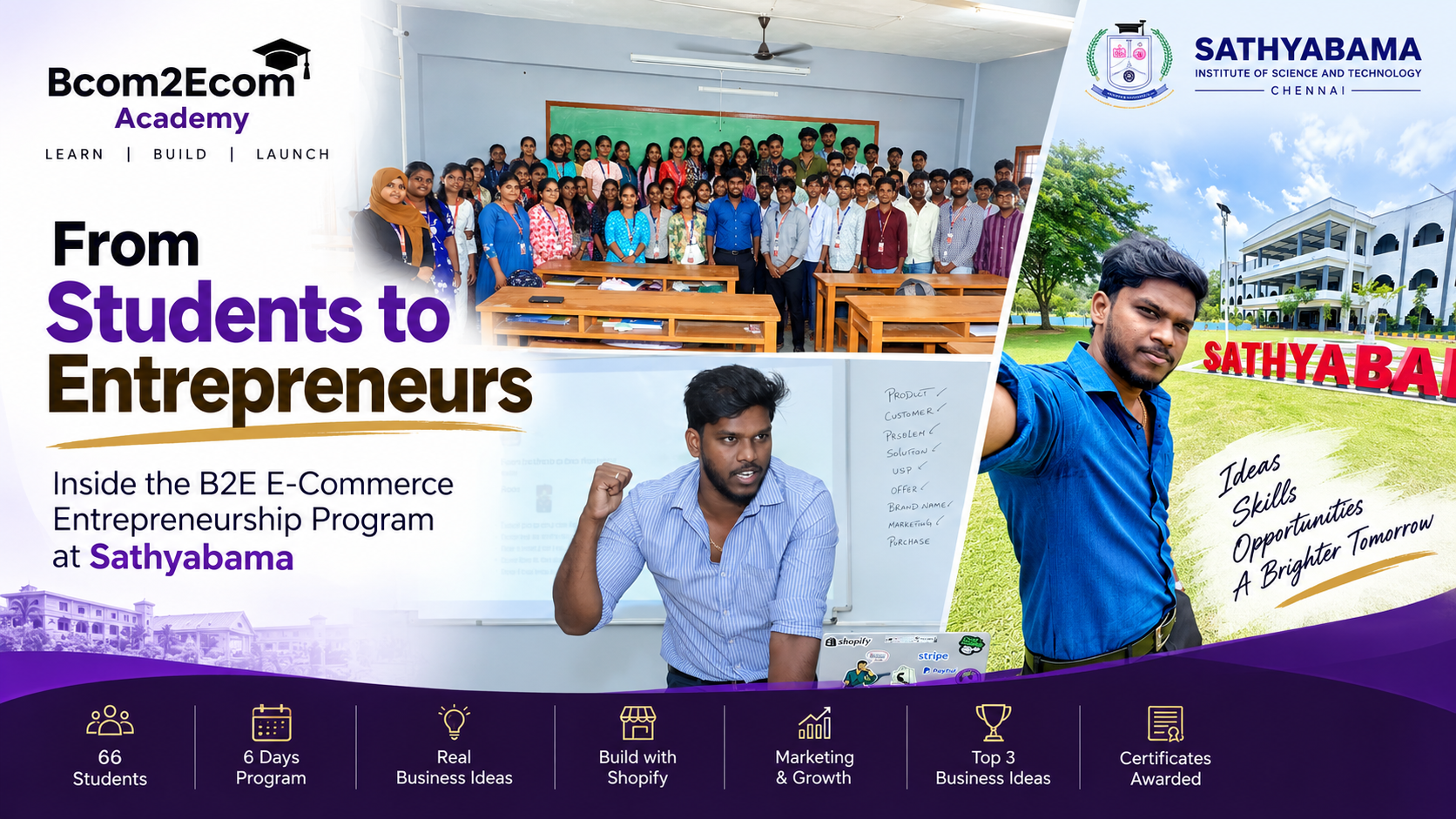
What happens when college students stop learning entrepreneurship only from textbooks and start building? I recently conducted a 6-day B2E E-Commerce Entrepreneurship Program at Sathyabama Institute of Science and Technology, where 66 students researched products, studied customers and competitors, built e-commerce stores, explored marketing and developed their own business ideas.
From 12 Arrears to Teaching Entrepreneurship: Inside the B2E E-Commerce Entrepreneurship Program at Sathyabama
There was a time when I was sitting on the other side of the classroom.
I was a student.
I had 12 arrears.
At that stage of my life, I didn't have a clear roadmap for entrepreneurship. I didn't know that one day I would build businesses, start Bcom2Ecom Academy, and stand in front of college students teaching them how to research markets, build e-commerce stores and develop business ideas.
But that is exactly what happened.
Recently, I had the opportunity to conduct a 6-day B2E E-Commerce Entrepreneurship Program at Sathyabama Institute of Science and Technology in Chennai for a batch of 66 students.
For me, this was much more than a college workshop.
It was a full-circle moment.
I was once the student who was struggling to figure things out.
Now, I was standing in a classroom helping another group of students figure out where they could start.
Why We Designed This E-Commerce Entrepreneurship Program
Entrepreneurship education shouldn't stop at explaining what entrepreneurship means.
Students should get an opportunity to experience the process of building a business.
That's why the B2E E-Commerce Entrepreneurship Program was designed around practical learning.
Instead of only discussing concepts, students worked through a complete business-building journey:
Product → Customer → Market → Competitor → Brand → Pricing → Store → Marketing → Business Idea
The goal wasn't to turn 66 students into successful entrepreneurs in six days.
That wouldn't be realistic.
The goal was more important:
Give students the knowledge, tools and confidence to start thinking and building like entrepreneurs.
Day 1: Understanding E-Commerce & Entrepreneurship
We began by understanding the fundamentals of e-commerce and entrepreneurship.
What is e-commerce?
How does an online business actually work?
What opportunities exist?
What does it take to build an online business?
But more importantly, we started changing the way students looked at business.
Instead of only asking:
"What job can I get?"
we started asking:
"What problem can I solve?"
That shift in thinking is one of the foundations of entrepreneurship.
Day 2: Product, Customer, Market & Competitor Research
A business doesn't start with a logo.
It starts with an opportunity.
Students learned how to research potential products and understand the people who might actually buy them.
They worked on:
Product research
Customer problems
Target customers
Market opportunities
Competitor research
Competitor pricing
Existing offers
Customer needs
We also introduced students to AI-assisted research.
The objective wasn't to tell students to let AI do everything for them.
It was to teach them how to use AI as a research and thinking assistant.
The better the question, the better the research.
And the better the research, the better the business decision.
Day 3: Branding, Suppliers, Pricing & Offers
Finding a product is only the beginning.
The next question is:
Why should a customer buy from you?
Students explored the fundamentals of:
Brand positioning
Value proposition
Unique selling proposition
Supplier sourcing
Product costs
Selling price
Profit margins
Offers
This helped students understand an important business principle:
A product is not automatically a business.
A business needs positioning, pricing, customers, an offer and a reason for people to choose it.
Day 4: Building an E-Commerce Store with Shopify
Ideas become much more real when you start building them.
On Day 4, students worked with Shopify and learned how an e-commerce store comes together.
They explored the practical side of turning a business idea into an online storefront.
This included understanding how products, pages, branding and customer experience work together.
Instead of simply looking at an example online store, students started thinking:
"How would I build my own?"
That is an important transition from learning to doing.
Day 5: Marketing & Customer Acquisition
A great product doesn't automatically get customers.
Customers need to discover it.
So we moved into marketing and customer acquisition.
Students explored:
Organic marketing
Content ideas
Marketing hooks
Problem-based content
Educational content
UGC and testimonials
Customer acquisition
Meta Ads
Campaign structure
Advertising metrics
We also discussed the numbers behind customer acquisition.
For example:
Impressions → Clicks → Website Visits → Add to Cart → Checkout → Purchase
Students need to understand that marketing isn't simply about creating a beautiful advertisement.
The real question is:
Can you consistently turn attention into customers and customers into a sustainable business?
Day 6: Capstone Project & Business Ideas
The final day was about bringing everything together.
Students worked on their capstone projects and developed their business ideas using what they had learned throughout the program.
They had to think about their:
Product
Target customer
Market
Competitors
Brand
Pricing
Store
Marketing strategy
Business opportunity
Then came one of the most important parts:
Presenting the idea.
Because having an idea is one thing.
Being able to explain why the idea makes sense is another.
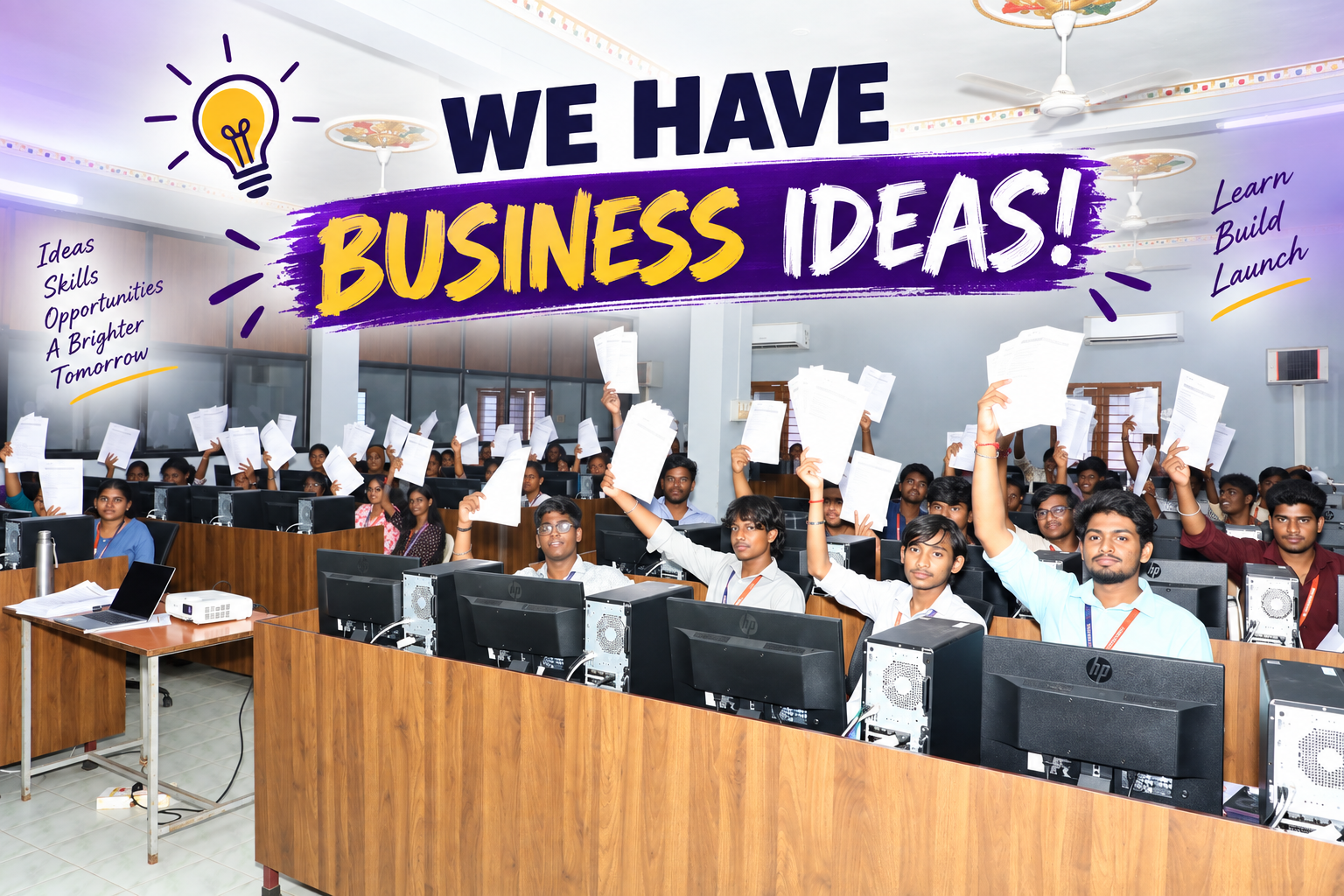
66 Students. 66 Business Ideas.
One of my favourite parts of the program was seeing students move from simply attending a class to actually holding a business idea in their hands.
They weren't expected to have perfect businesses.
They weren't expected to become entrepreneurs overnight.
They were expected to start.
And that's what matters.
A business idea can change.
A product can change.
A target customer can change.
A brand can change.
But the ability to research, test, learn and adapt stays with you.
Recognising Students Who Built, Participated & Took Initiative
We also wanted to make the completion of the program meaningful.
Students received certificates for completing the B2E E-Commerce Entrepreneurship Program, including their capstone project.
We also introduced special recognition for students who stood out during the program.
B2E Business Visionary
The Top 3 Business Ideas were recognised for their creativity, business thinking and potential.
The award wasn't about who had already built a successful company.
It was about recognising the quality of the business idea and entrepreneurial thinking behind it.
B2E Active Learner
We also recognised students who demonstrated:
Curiosity • Initiative • Participation
Because active learning matters.
The students who ask questions, participate, experiment and take initiative often get much more from an entrepreneurial learning experience.
And every student who completed the program received the:
"I BUILT MY FIRST BUSINESS IDEA" Medal
I particularly like this recognition.
Because it doesn't say:
"I built a million-dollar business."
It says:
"I built my first business idea."
And every entrepreneur has to start somewhere.
Why Practical Entrepreneurship Education Matters
I believe college students deserve more opportunities to build.
Not because traditional education isn't valuable.
It is.
But because entrepreneurship is a skill that becomes much clearer when students actually experience the process.
Imagine learning marketing and then creating a marketing strategy.
Learning customer research and then researching a real customer.
Learning business and then developing a business idea.
Learning e-commerce and then building an online store.
Learning AI and then using AI to accelerate research.
That's when education becomes practical.
That's when students start connecting knowledge with action.
What My Own Journey Taught Me
My own journey is probably the biggest reason I care about this.
I had 12 arrears in college.
I struggled academically.
I didn't have everything figured out.
But those struggles didn't decide how my story would end.
During the COVID lockdown, I discovered e-commerce and dropshipping and started learning.
I had to figure things out step by step.
Products.
Customers.
Marketing.
Websites.
Sales.
Failures.
Business.
That journey eventually led me to build Bcom2Ecom and start teaching others.
And today, when I stand in front of a classroom full of students, I remember where I started.
That's why I don't look at a student's current academic performance and decide what their future will be.
A student's current chapter is not their entire story.
What Comes Next for Bcom2Ecom Academy?
The Sathyabama program is one chapter in a much bigger vision.
Through Bcom2Ecom Academy, my goal is to bring practical e-commerce and entrepreneurship education to more college campuses and help more students understand how online businesses are actually built.
The vision is simple:
Learn. Build. Launch.
Students should leave a program not just with notes, but with something they can continue working on.
A product idea.
A customer profile.
A market opportunity.
A brand.
A store.
A marketing strategy.
And most importantly, the confidence to take the next step.
From 12 Arrears to the Classroom
If there is one message I want students to take from my journey, it is this:
Don't allow one chapter of your life to become the title of your entire story.
I had 12 arrears.
I struggled.
I learned.
I experimented.
I failed.
I started again.
And eventually, I found my path through e-commerce and entrepreneurship.
Today, I get the opportunity to teach students some of the things I wish I had known when I was sitting in that classroom.
That is something I don't take for granted.
The Next Entrepreneur Could Be Sitting in Your Classroom
Every college classroom has students who are still figuring themselves out.
Some will become entrepreneurs.
Some will become marketers.
Some will build products.
Some will join companies.
Some will create something completely unexpected.
We don't know yet.
And that's okay.
Our responsibility as mentors isn't to decide what every student's future should be.
It's to give them the exposure, tools, guidance and confidence to build it themselves.
The Sathyabama B2E E-Commerce Entrepreneurship Program was six days.
But for some students, the idea they built during those six days could become the starting point for something much bigger.
And that's the real purpose of entrepreneurship education.
Not to teach students how to dream about building a business.
But to give them the courage and practical skills to start building one.
One student. One idea. One campus at a time.
This is just the beginning.
-------------------------------------------------------------------------------
Want to Bring E-Commerce Entrepreneurship to Your Campus?
If you are a college, university, department, placement cell, entrepreneurship cell, or faculty member looking to introduce students to practical e-commerce and entrepreneurship, we’d love to connect.
We conduct practical E-Commerce Entrepreneurship Programs, workshops, and campus training sessions designed to help students move from learning concepts to actually building business ideas.
📩 For campus collaborations and workshops: campus@bcom2ecom.in
Let’s help students move from simply preparing for jobs to learning how to build opportunities of their own.
Bcom2Ecom Academy
Learn. Build. Launch.


