
India's AI Opportunity: How Small Businesses Can Benefit From Artificial Intelligence
AI is no longer limited to large technology companies. For India's entrepreneurs and small businesses, artificial intelligence could become a powerful tool for productivity, innovation and growth.
India's AI opportunity extends far beyond startups building AI models. Millions of entrepreneurs and small businesses can use artificial intelligence for marketing, research, customer service, operations and decision-making. Here's how AI could reshape the future of Indian business.
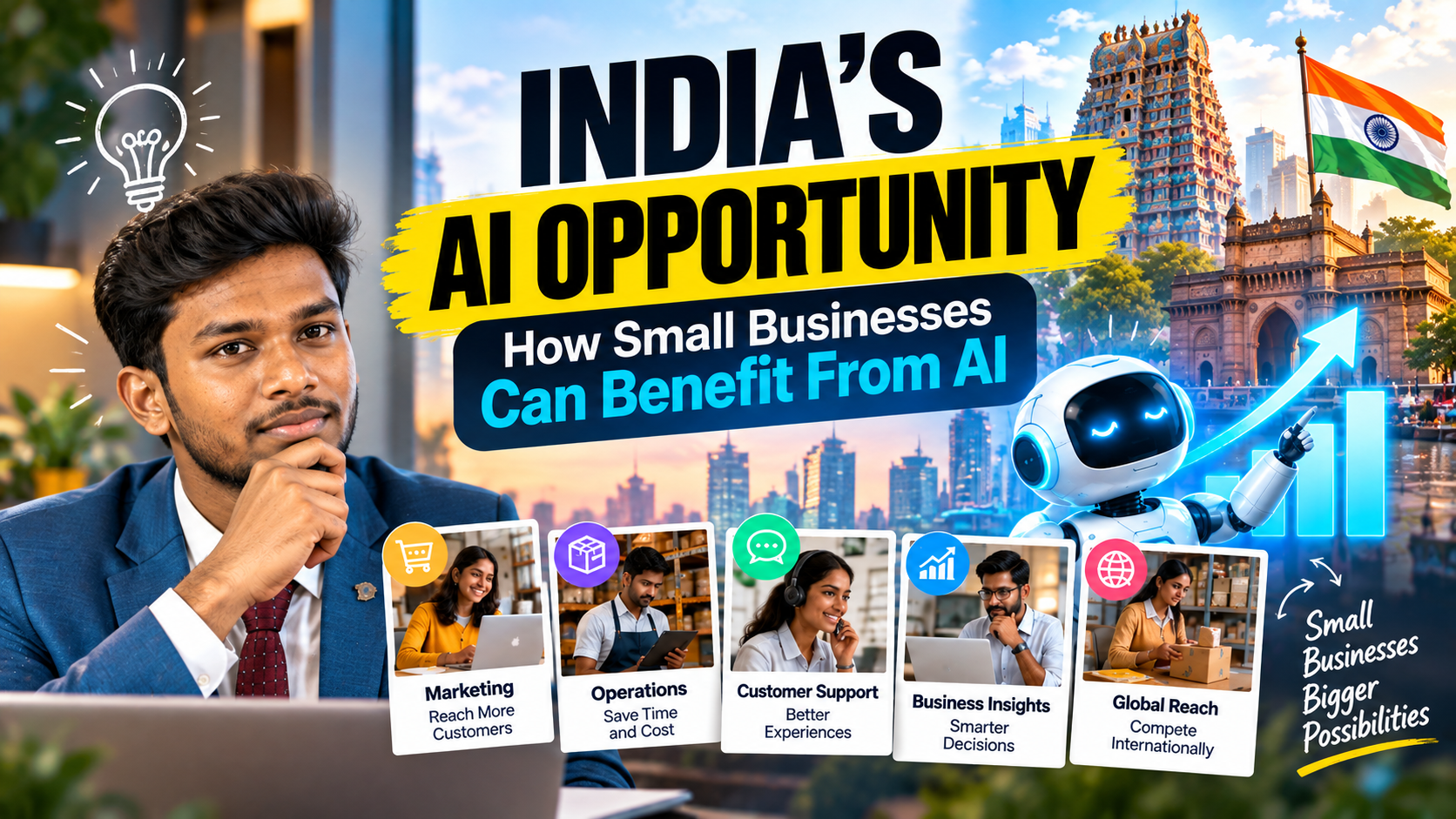
India's AI Opportunity Is Bigger Than Technology
When people talk about India's artificial intelligence opportunity, the conversation often focuses on technology companies, startups and software engineers.
But there is another opportunity that may be equally important.
How can millions of Indian businesses use AI to become more capable?
India has a huge base of:
Small businesses
Entrepreneurs
Service businesses
Manufacturers
Retailers
E-commerce companies
Freelancers
Professionals
Startups
Most of these businesses don't have large technology teams.
Many operate with small teams and limited resources.
Artificial intelligence could change that equation.
AI Can Give Small Businesses Access to More Capabilities
Consider a small business with five employees.
It may not be able to hire dedicated teams for:
Market research
Content marketing
Data analysis
Customer support
Competitor research
Software development
Business intelligence
But AI tools can potentially provide assistance across many of these areas.
A business owner can use AI to:
Research a market → Analyse competitors → Create marketing content → Understand customer feedback → Automate support → Analyse business data → Improve operations
The technology doesn't replace the entrepreneur.
It increases the entrepreneur's available capability.
Why This Matters Particularly in India
India has millions of businesses operating at very different levels of technological maturity.
Some companies have sophisticated software systems.
Others still manage significant parts of their business through spreadsheets, messaging apps and manual processes.
AI could potentially help bridge some of that gap.
A small business doesn't necessarily need to build its own AI model.
It can use existing AI capabilities through software products and APIs.
That lowers the barrier to entry.
And lower barriers can create more experimentation.
AI and Indian Entrepreneurship
India has become one of the world's major startup and entrepreneurship ecosystems.
But entrepreneurship isn't limited to venture-backed startups.
The majority of business activity happens through small and medium businesses.
For these entrepreneurs, AI can become a practical business tool.
Imagine a local business owner who wants to expand.
Previously, they might need external consultants or specialised employees to conduct:
Market research
Competitor analysis
Marketing planning
Customer segmentation
Content creation
AI can now assist with parts of these activities.
The entrepreneur still needs judgement.
But the starting point becomes much stronger.
AI Can Reduce the Cost of Knowledge Work
One of the most interesting effects of AI is the declining cost of certain types of knowledge work.
Tasks that previously required hours of manual effort can increasingly be assisted by AI.
For example:
Marketing
AI can help generate campaign concepts, content ideas and creative variations.
Customer Service
AI can answer routine questions and help categorise support requests.
Research
AI can help organise large amounts of information.
Finance
AI can assist with financial analysis and reporting.
Operations
AI can help identify repetitive processes and create automation workflows.
E-commerce
AI can assist with product research, product descriptions, customer analysis and marketing.
This doesn't eliminate the need for expertise.
It makes expertise more scalable.
AI Could Become a Force Multiplier for Indian Founders
A founder with a small team has one major limitation:
Attention.
There are always more decisions, problems and opportunities than the team can handle.
AI can potentially act as a force multiplier.
A founder can use AI to process more information without personally reviewing every piece of it.
For example:
Customer Feedback
       ↓
AI Analysis
       ↓
Common Problems
       ↓
Product Insights
       ↓
Founder Decision
The AI doesn't make the final business decision.
It helps the founder see the pattern faster.
That's a meaningful advantage.
The Opportunity Isn't Just AI Adoption
There is a difference between:
using AI
and
building a business around AI-enabled capabilities.
A business might use AI to write social media captions.
That's useful.
But a more strategic business might redesign its entire marketing workflow around AI.
Instead of:
Idea → Employee → Draft → Review → Publish
it could become:
Customer Data → AI Analysis → Content Ideas → Human Review → Multi-channel Distribution
The second approach is not simply using an AI tool.
It is redesigning the workflow.
That's where larger productivity gains may come from.
AI Can Help Indian Businesses Compete Globally
One of the biggest opportunities is international competitiveness.
A small Indian business can potentially use AI for:
International market research
Translation
Customer communication
Marketing
Product research
Sales support
Website localisation
Competitive analysis
Language barriers and information gaps can become easier to manage.
This could make it easier for smaller businesses to explore international markets.
Again, AI doesn't guarantee success.
A good product, strong execution and customer demand still matter.
But AI can reduce some of the friction involved in reaching new markets.
The Importance of Indian Languages
Another major opportunity is India's linguistic diversity.
AI systems increasingly support multiple languages and can help bridge communication gaps.
This could have important implications for:
Education
Customer service
Government services
Business software
Financial services
Entrepreneurship
Technology becomes more accessible when people can interact with it in languages they are comfortable using.
For a country as linguistically diverse as India, this could be particularly significant.
What Small Businesses Should Start Doing Today
Businesses don't need to implement everything at once.
Start with simple problems.
1. Identify repetitive tasks
What does your team do every day or every week?
2. Find information-heavy processes
Where are employees spending time collecting and organising information?
3. Test AI on low-risk workflows
Start with content, research, summaries and internal processes.
4. Measure the result
Track time saved and quality improvements.
5. Build repeatable workflows
Don't rely on random prompting.
Create systems your team can consistently use.
6. Train your team
AI adoption isn't just a software problem.
People need to understand how to use the technology effectively.
What Could Hold Indian Businesses Back?
AI adoption also comes with challenges.
Lack of AI literacy
Many businesses don't know where AI can actually create value.
Data quality
Poor business data produces poor insights.
Trust
Businesses need to understand the limitations of AI-generated information.
Privacy and security
Sensitive business and customer information needs to be handled carefully.
Over-automation
Not every business process should be automated.
Tool overload
Buying dozens of AI subscriptions doesn't create an AI strategy.
The goal isn't to use AI everywhere.
It's to use it where it creates measurable value.
India Should Not Only Consume AI
This is perhaps the bigger opportunity.
India can be both:
A consumer of AI
and
a builder of AI-powered businesses.
Indian entrepreneurs don't necessarily need to compete by building foundational AI models.
There are opportunities much closer to the customer.
AI-powered:
Business software
Education
Healthcare
E-commerce
Financial services
Agriculture
Manufacturing
Logistics
Customer support
Local-language applications
The biggest opportunities may emerge when entrepreneurs combine AI with deep understanding of a specific problem.
Technology alone isn't enough.
Domain knowledge matters.
AI and the Future of Indian Small Businesses
The future Indian business environment could look very different.
A small team may have access to:
AI marketing assistants
AI research systems
AI customer support
AI financial analysis
AI sales assistance
AI business intelligence
AI automation agents
This doesn't mean businesses will need fewer humans everywhere.
It means each person may be able to accomplish more.
That could change the economics of entrepreneurship.
A founder with five highly capable people and the right AI systems could potentially operate with capabilities that once required a much larger organisation.
The Bigger Opportunity
The AI opportunity for India isn't simply about creating more AI startups.
It is about increasing the capabilities of the entire business ecosystem.
If millions of Indian entrepreneurs become more productive, better informed and more capable of competing globally, the impact could extend far beyond the technology industry.
AI could become infrastructure for entrepreneurship.
And that is a much bigger opportunity to think about.
Final Thoughts
Artificial intelligence is changing the way businesses operate around the world.
For India, the opportunity is particularly interesting because of the country's enormous entrepreneurial ecosystem.
The biggest question isn't:
"How many Indian companies will use AI?"
It's:
"How much more capable can Indian businesses become because AI exists?"
That is the opportunity worth watching.
For entrepreneurs, the next step isn't to learn every AI tool.
It's to identify the problems that consume time, money and attention — and then ask:
Can AI help us solve them better?
That's where the real value begins.
Continue Reading
The Future of Work in the Age of Agentic AI: Jobs, Productivity, Human Value and India's Opportunity


