
Will AI Replace Jobs? Understanding the Future of Work
AI is changing how work gets done, but the future isn't simply about humans losing jobs to machines. It's about how tasks, roles, skills and entirely new forms of work will evolve.
Will AI replace jobs? The answer is more complicated than a simple yes or no. Artificial intelligence is already automating tasks, changing job roles and creating new opportunities. Here's what entrepreneurs and professionals should understand about the future of work.
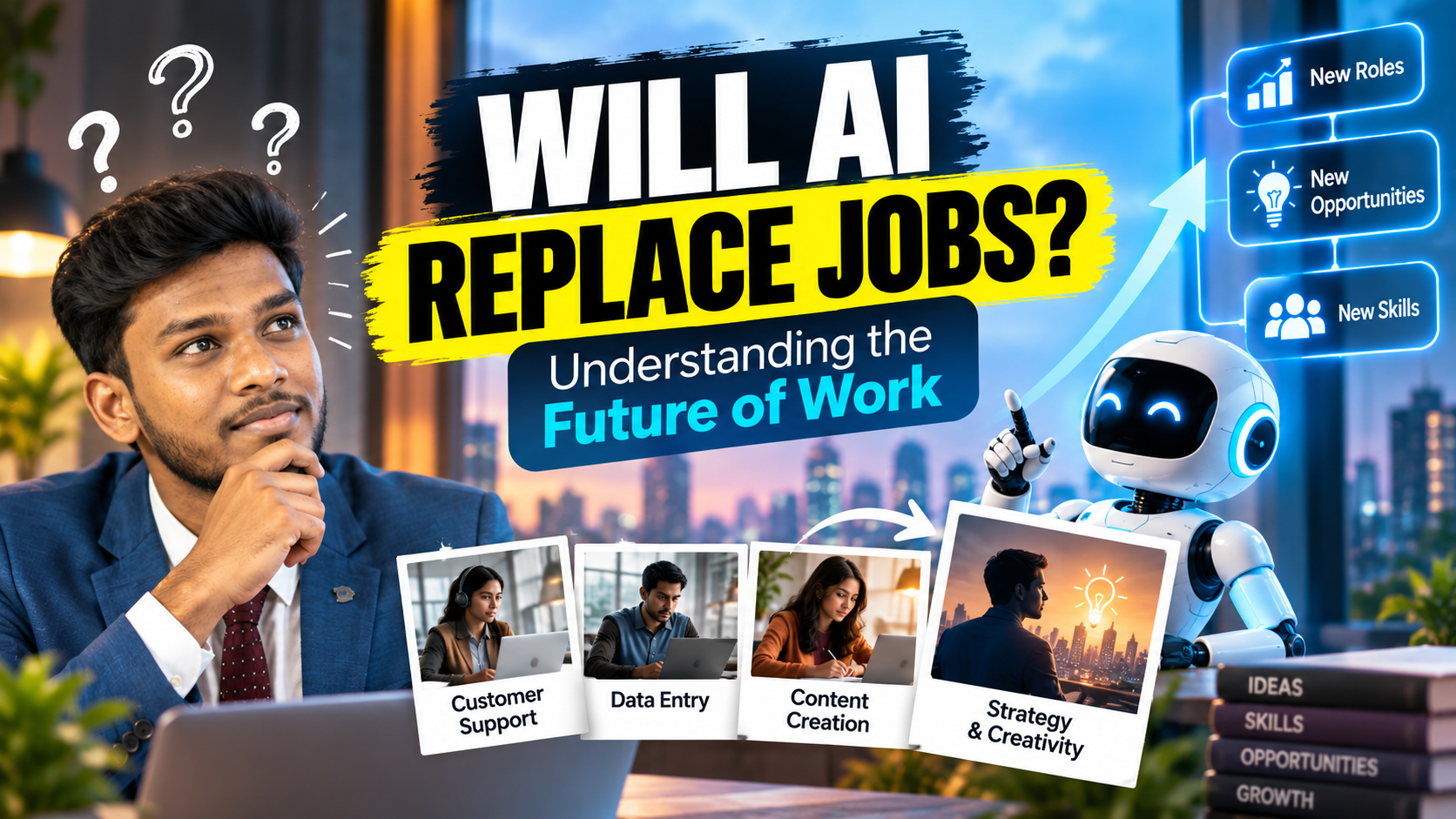
Will AI Replace Jobs?
Few questions about artificial intelligence create as much anxiety as this one:
Will AI replace my job?
With the rapid growth of generative AI, AI automation and Agentic AI, machines are becoming capable of performing tasks that previously required human effort.
AI can write content.
It can analyse data.
It can generate images.
It can write software.
It can answer customer questions.
It can conduct research.
And increasingly, AI agents can complete multiple steps toward a goal with less human intervention.
So it is understandable that people are asking whether artificial intelligence will eventually replace human workers.
But looking at the future simply as "AI versus jobs" misses a much bigger transformation.
The more useful question is:
Which tasks will AI automate, which jobs will change, and what new forms of work will emerge because of AI?
AI Usually Automates Tasks Before It Replaces Entire Jobs
One of the most important distinctions in the AI and jobs discussion is the difference between a task and a job.
A job is usually made up of many different activities.
For example, a marketing manager might:
Research customers
Analyse competitors
Create campaigns
Write briefs
Review creative work
Talk to customers
Coordinate with a team
Analyse performance
Make strategic decisions
AI might automate some of these activities.
That doesn't automatically mean the entire marketing role disappears.
Instead, the role changes.
The person may spend less time producing routine work and more time making decisions, understanding customers and developing strategy.
This is why the future of work is likely to involve significant job transformation, not simply job elimination.
What AI Is Particularly Good At
AI systems are becoming increasingly capable at tasks involving information processing.
Some examples include:
1. Repetitive work
Tasks that follow predictable patterns are strong candidates for automation.
2. Information processing
AI can process and summarise large volumes of information very quickly.
3. Content generation
Text, images, presentations, videos and other forms of content can increasingly be produced with AI assistance.
4. Data analysis
AI can help identify patterns, generate reports and assist with analytical work.
5. Customer support
Many routine customer questions can be answered automatically.
6. Research
AI can accelerate the process of gathering and organising information.
7. Software development
AI coding assistants can generate, explain, debug and modify code.
The common thread is that many of these activities involve processing information according to patterns or objectives.
That makes them increasingly suitable for AI assistance or automation.
But Human Work Is More Than Task Execution
A business isn't simply a collection of tasks.
People make decisions under uncertainty.
They build relationships.
They understand context.
They negotiate.
They lead teams.
They create trust.
They identify problems that nobody has clearly defined yet.
They decide what is worth building.
These are fundamentally different from simply completing a predefined task.
This is where human capabilities continue to matter.
And ironically, as AI becomes better at routine cognitive work, these capabilities may become even more important.
The Future of Work May Be Human + AI
Instead of thinking:
Human vs AI
we may need to start thinking:
Human + AI
Consider a small business owner.
Previously, they might have needed separate people or external providers for:
Market research
Content creation
Customer support
Data analysis
Website development
Copywriting
Administrative work
AI doesn't necessarily eliminate the need for the business owner.
It can give that person access to capabilities that were previously difficult or expensive to obtain.
A founder with AI tools may be able to operate with a much smaller team while still accomplishing more.
This could become one of the most significant effects of AI on entrepreneurship.
AI Could Change the Economics of Small Businesses
Large companies have traditionally had an advantage because they can afford specialised teams.
A large organisation might have dedicated:
Marketing teams
Data analysts
Developers
Researchers
Customer support teams
Designers
Operations managers
A small business may have only a handful of people.
AI can potentially narrow some of that capability gap.
A small team can now access sophisticated tools for research, content, analysis, automation and customer support.
That doesn't mean small businesses automatically become successful.
Execution still matters.
Product-market fit still matters.
Distribution still matters.
Capital still matters.
But the cost of accessing certain capabilities is falling.
That could create new opportunities for entrepreneurs.
Agentic AI Could Accelerate This Change
Generative AI is already useful for producing content and answering questions.
Agentic AI introduces another layer.
Instead of simply responding to a prompt, an AI agent can potentially:
Understand a goal
Break the goal into tasks
Use different tools
Perform actions
Evaluate results
Continue working toward the objective
Imagine telling an AI system:
"Analyse my competitors and prepare a weekly market intelligence report."
Instead of simply giving you an answer, an agent could potentially gather information, analyse it, organise it and produce the report according to predefined instructions.
This is why Agentic AI could have a significant impact on business operations.
The question shifts from:
"Can AI help me with this task?"
to:
"Can AI manage this workflow?"
That is a much bigger change.
So Which Jobs Could Be Most Affected?
It is difficult to predict individual occupations with certainty.
But jobs containing a high proportion of repetitive, predictable or information-processing tasks are likely to experience greater AI-driven change.
That doesn't necessarily mean the jobs disappear.
They may instead evolve.
For example:
Customer Support
From manually answering every question to supervising AI-powered support systems.
Marketing
From manually producing every asset to directing AI-assisted creative and analytical workflows.
Accounting
From manually processing information to reviewing AI-generated financial analysis and exceptions.
Software Development
From writing every line of code manually to designing systems and reviewing AI-generated code.
Research
From manually collecting information to validating and interpreting AI-assisted research.
The role changes from doing every task to managing, validating and making decisions around the work.
New Jobs Will Also Emerge
Every major technological transformation creates new needs.
AI is already creating demand for roles involving:
AI implementation
AI product development
AI governance
AI operations
Data management
AI training
AI workflow design
Automation
AI security
Human-AI interaction
There will also likely be jobs that are difficult to predict today.
That's one of the problems with trying to forecast the future of work purely by looking at today's job titles.
A decade ago, many people wouldn't have predicted the exact scale of careers around social media, creator businesses, app ecosystems and other digital platforms.
The same could happen with AI.
The Skills That May Become More Valuable
As AI handles more routine work, people may need to develop skills that complement rather than compete directly with AI.
These can include:
Critical thinking
Being able to evaluate whether an AI-generated answer is actually correct.
Problem definition
Knowing what problem needs to be solved in the first place.
Communication
Being able to communicate clearly with customers, employees and stakeholders.
Creativity
Generating original ideas and connecting concepts in new ways.
Leadership
Making decisions and taking responsibility for outcomes.
Domain expertise
Understanding a specific industry deeply enough to recognise when AI is wrong or incomplete.
AI literacy
Knowing how to use AI effectively without blindly trusting it.
The advantage may increasingly belong to people who combine domain expertise + AI capability.
What Does This Mean for Students?
Students entering the workforce today face a very different environment from previous generations.
Learning a single technical skill and expecting it to remain unchanged for decades may become increasingly risky.
Instead, students should develop the ability to:
Learn continuously
Understand technology
Communicate clearly
Solve problems
Work with AI
Think critically
Build projects
Understand business
The goal shouldn't be to compete with AI at tasks where AI is becoming better.
The goal should be to learn how to work alongside increasingly capable technology.
What Does This Mean for Entrepreneurs?
For founders, the AI revolution creates a different responsibility.
Don't just ask:
"Which AI tool should I subscribe to?"
Ask:
What can I automate?
Identify repetitive workflows.
What can I delegate to AI?
Look for information-heavy tasks.
What can I build because AI is now available?
This is where new business opportunities appear.
What problems are becoming more important?
As technology changes, customer needs change too.
How can I create more value?
This is the most important question.
AI isn't valuable simply because it is AI.
It is valuable when it solves a meaningful problem.
The Biggest Mistake Businesses Can Make
One of the easiest mistakes during an AI boom is becoming obsessed with the technology itself.
A company might say:
"We need to implement AI."
But why?
What problem are you solving?
What customer experience are you improving?
What cost are you reducing?
What new capability are you creating?
Technology should follow the business problem.
Not the other way around.
The companies that benefit from AI won't necessarily be the ones using the largest number of AI tools.
They will be the ones that understand where AI actually creates economic value.
AI Will Change Work. That Doesn't Mean Humans Become Irrelevant.
The future of work is unlikely to be as simple as:
AI replaces humans.
A more realistic possibility is:
AI changes what humans spend their time doing.
Some tasks will disappear.
Some jobs will change.
New jobs will emerge.
Small businesses may gain capabilities that previously required large teams.
Entrepreneurs may be able to build with fewer resources.
And people who learn to combine their expertise with AI may gain capabilities that neither humans nor AI could achieve as effectively alone.
The important question isn't only:
"Will AI take my job?"
A better question is:
"How will my work change when AI becomes part of it?"
And for entrepreneurs:
"What can I build now that wasn't economically possible before AI?"
Those questions are much more useful for preparing for the future.
Final Thought
AI is not simply another software trend.
It is changing the economics of knowledge work.
The people who adapt won't necessarily be those who know every new AI tool.
They will be the people who understand how to use technology to solve real problems, create value and continuously reinvent the way they work.
The future of work isn't being decided by AI alone.
It is being shaped by what humans choose to do with it.
Continue reading: [The Future of Work in the Age of Agentic AI: Jobs, Productivity, Human Value and India’s Opportunity]


